
Micropaleontological Reference Centers (MRCs)
Introduction
Since 1968, deep-sea drilling ships have recovered sediment cores from all the major ocean basins. This wealth of deep-sea material has yielded a unique record of biologic evolution in the form of abundant preserved skeletons of marine microfossils. These fossils are important for synthesising larger scale patterns of plankton evolution, to determine the geologic age of sediments and are key recorders of past environmental change. The Micropaleontological Reference Centers (MRCs) have been developed over a 30 year period to provide a scientific collection of this microfossil record (see MRC history).
Maintained by curators at over a dozen sites around the world, the Micropaleontological Reference Centers (MRCs) provide scientists with an opportunity to examine microfossils of various geologic ages, and from a globally distributed set of locations. The collections, with more than 20,000 samples, cover four microfossil groups—calcareous nannofossils, foraminifers, radiolarians, and diatoms—selected from sediment cores obtained from the Deep Sea Drilling Project (DSDP), the Ocean Drilling Program (ODP), and the Integrated Ocean Drilling Program (IODP). The MRCs are a source of materials for current research and are a legacy archive for deep sea drilling. The MRCs also accept selected "orphaned" collections of deep-sea microfossil materials.
The organization is supervised by a lead curator (currently David Lazarus, Natural History Museum, Berlin, Germany) together with the other scientists that make up the MRC network (see MRC Institutions and Supervisors).
MRC Use
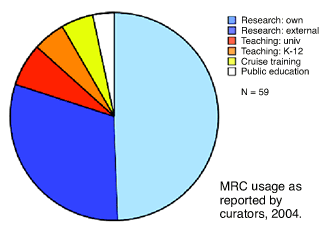
Typically more than 50 scientists or their students make use of MRC collections each year. Most of this is for research purposes. MRCs are also used at a few universities for teaching, and there is a small amount of K-12 teaching and public outreach education as well. MRC collections are used normally by visiting one of the MRC repositories, although qualified scientists can also be sent materials directly on loan. To schedule a visit or obtain more information, contact the Supervisor at each location.
All of the complete MRCs maintain identical sets of microfossil preparations. Satellite institutions maintain subset MRC collections according to the micropaleontological expertise of their research staff. Each MRC repository also provides all neccessary equipment and literature (e.g., DSDP/ODP volumes; microscopes) needed to carry out research on the collections they hold.